
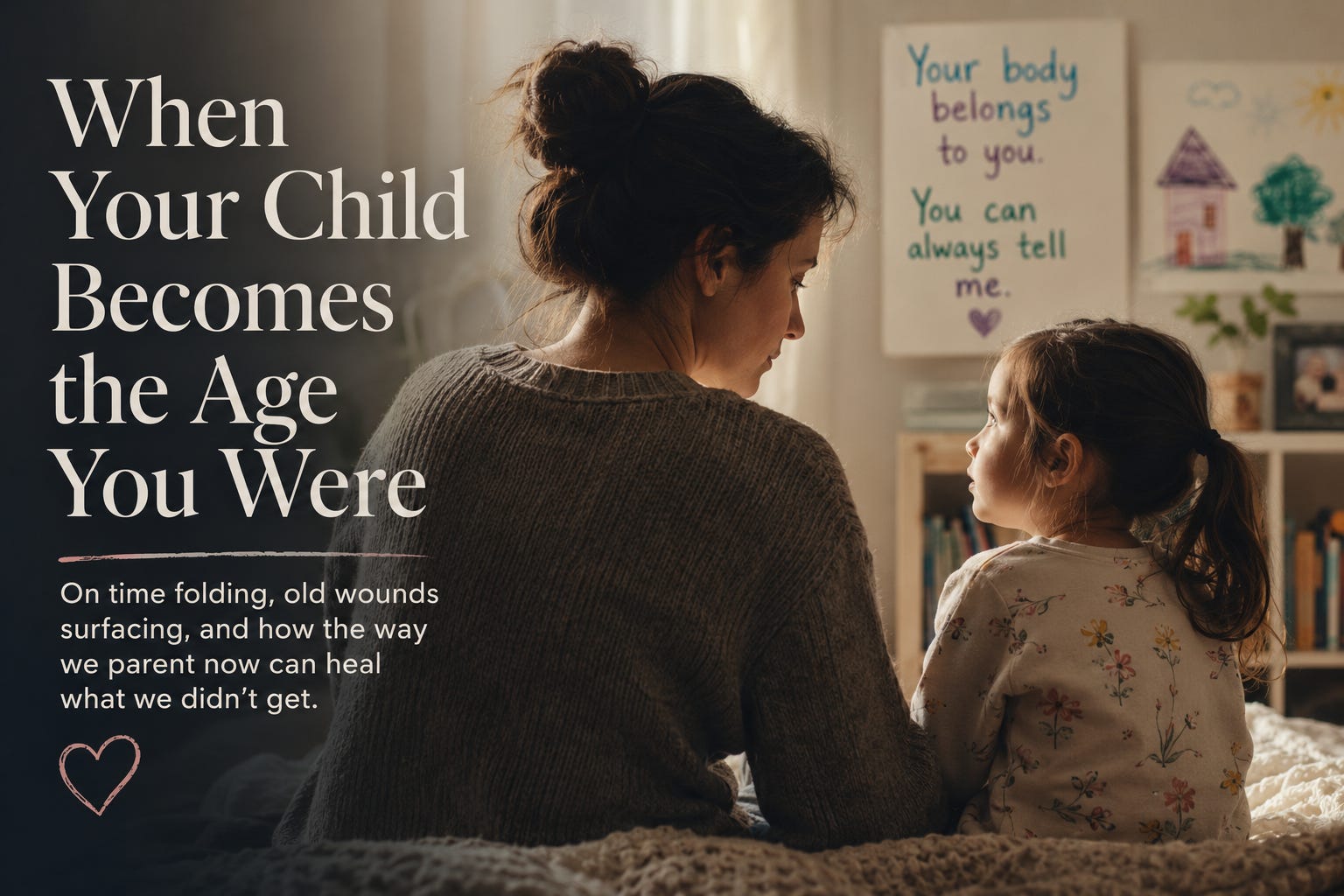
No one tells you that a child can walk you back into your own childhood. You expect the sleepless nights and the school forms and the tantrums in the cereal aisle. You don’t expect the morning you look up from the bench and feel something drop in your chest, because the child in front of you has just reached the exact age you were when something happened to you.
For some parents it’s six. For some it’s eight, or eleven, or three months. The number isn’t the point. The point is that time folds, and for a moment the child you’re raising and the child you used to be are standing in the same body.
One share. One parent. One child safer.
Developmental psychologists have a fairly unromantic explanation for this. Becoming a parent is one of the few times in adult life that you’re pulled back through every stage of childhood in order, at close range, in real time. Your child’s age becomes a cue. The early years of parenting are described in the literature as a period when your internal model of childhood, the one you built before you had words for it, gets reopened and reworked. Most of the time this happens quietly, under the surface. Sometimes it doesn’t.
The moment parents describe to me sounds almost the same every time. They’re watching their child do something small. Losing a tooth. Falling asleep mid-sentence. Asking for help with a stuck zip. And they think: she’s so little. He’s so small. And then, underneath that, the thought that changes everything. How could anyone have done that to a child this size?
Here’s the part I think gets talked about least.
A lot of survivors spend years quietly shrinking what happened to them. You tell yourself you were older than you were, tougher than you were, more responsible for it than a child could possibly be. Minimising is how a lot of people get through. Then you have a child, and that child reaches your age, and the minimising stops working. You can see it now, with your own eyes. Exactly how small you were. Exactly how little you could have done. Exactly how much it was never yours to carry. That recognition can arrive as grief. It can also arrive as a rage that surprises you, usually pointed at the adults who were meant to protect you and didn’t.
It doesn’t stay a feeling, either. It shows up in how you parent. When something your child does lands on an old wound, you can stop responding from the present and start responding from the trauma. That’s fight, flight or freeze running the show instead of you. Sometimes it’s fight, and you find yourself locked in a battle with a six year old over something that, underneath, is really about your own shame or embarrassment. Sometimes it’s re-enactment, and you hear your own parent come out of your mouth doing the exact thing you swore you never would. And sometimes it’s the opposite. A kind of freeze, where you can’t set a limit or manage a behaviour at all, because discipline was weaponised against you and now any version of it feels like harm. None of this makes you a bad parent. It makes you a parent with a nervous system that learned its lessons early and is still trying to protect you from a danger that’s long gone.
Then there’s the response that hides the deepest. Dissociation is the mind’s way of putting something unbearable behind glass so a person can keep functioning. It works, and that’s the problem. Dissociative amnesia, the loss of access to a traumatic memory the mind has walled off, is a recognised clinical phenomenon, not a figure of speech. Plenty of adults move through life with no clear memory of what happened to them, or with one they’ve filed under “not that bad,” because the part of them that knows has been sealed off. Amy Griffin’s 2025 memoir The Tell describes this from the inside, the experience of running for decades from something she couldn’t name, until it surfaced. (Parts of her account are the subject of an ongoing legal dispute, which is worth knowing.) The point that matters for parents is the pattern, not any single story. A person can carry abuse they have no conscious access to, and a parent who has sealed off their own history can be the last to recognise the signs in their own child, because seeing them would mean unsealing the very thing they survived by not looking at.
I come to this as a psychologist, and as a mother whose own child was harmed inside a system that was supposed to be safe. So let me say plainly what that taught me. The distance between how vulnerable a young child actually is and how much the adults around them are willing to see is enormous. A two year old can’t lobby. Can’t testify well. Can’t make the grown-up world comfortable with what they’re trying to say. They depend entirely on an adult choosing to believe them. When that choice doesn’t get made, the harm isn’t only the thing that happened. It’s the silence that comes after it.
Which is, strangely, where the healing sits.
Not in the past changing. The past doesn’t change. It sits in what you do now, in front of a child who is the age you once were.
Every time you stop what you’re doing and actually listen to your child, you’re putting something on record that the younger you may not have received. Every time you believe them before you fully understand them. Every time you protect them when it’s inconvenient, when it makes other adults uncomfortable, when it’s easier to smooth it over. None of this fixes you through your child. Children aren’t a treatment, and they shouldn’t be asked to be one. It’s quieter than that. The act of parenting well puts the correct version of events in front of you, on repeat, until some part of you that had stopped expecting it starts to believe it was always meant to look like this.
This is also why I teach parents the unglamorous, practical things. Name body parts properly from 18 months. Tell your child that no adult should ask them to keep a secret from you or touch you. Ask who exactly is caring for your child when you’re not in the room, and don’t apologise for asking. These are tools for keeping your child safe, and that’s the first reason to use them.
But they’re also the sentences the younger you needed someone to say. Finally being said out loud, in your house, by you.
So I’ll leave you with the question rather than the answer.
When your child reaches the age you were, what do you want them to learn about what happens when a child speaks? You’re answering that now, in every ordinary morning, whether you mean to or not.
If this has stirred something up, you don’t have to sit in it on your own. Bravehearts (1800 272 831) supports adult survivors as well as families. And if you’re worried about a child right now, trust the worry. It’s allowed to be wrong. It isn’t allowed to be ignored.
—
Berthelot, N., Ensink, K., Bernazzani, O., Normandin, L., & Luyten, P. (2015). Intergenerational transmission of attachment in abused and neglected mothers: The role of trauma-specific reflective functioning. *Infant Mental Health Journal, 36*(2), 200–212.
Fraiberg, S., Adelson, E., & Shapiro, V. (1975). Ghosts in the nursery: A psychoanalytic approach to the problems of impaired infant-mother relationships. *Journal of the American Academy of Child Psychiatry, 14*(3), 387–421.
Lieberman, A. F., Padrón, E., Van Horn, P., & Harris, W. W. (2005). Angels in the nursery: The intergenerational transmission of benevolent parental influences. *Infant Mental Health Journal, 26*(6), 504–520.
Narayan, A. J., Lieberman, A. F., & Masten, A. S. (2021). Intergenerational transmission and prevention of adverse childhood experiences (ACEs). *Clinical Psychology Review, 85*, 101997.
Schechter, D. S., & Willheim, E. (2009). Disturbances of attachment and parental psychopathology in early childhood. *Child and Adolescent Psychiatric Clinics of North America, 18*(3), 665–686.
Slade, A. (2005). Parental reflective functioning: An introduction. *Attachment & Human Development, 7*(3), 269–281.
For parents wanting practical child safety information and support, Bravehearts provides evidence-based resources on body safety, protective behaviours, and support for survivors: https://bravehearts.org.au
Legal and Privacy Concerns. Under Australian privacy laws and for personal safety, the author uses a pseudonym and AI-altered imagery. This work features literary and reflective essays expressing a subjective lived experience; it is not a legal or investigative record. All references to harm or conduct reflect the author’s honest opinion and personal interpretation of events. Regarding the matters referenced, police investigations resulted in a finding of no offence detected; this work is an exploration of the psychological interpretations and healing that follow such experiences. While the author is a psychologist, the views expressed here are personal and do not constitute professional psychological advice or a clinical opinion.
Your voice belongs in this conversation.