
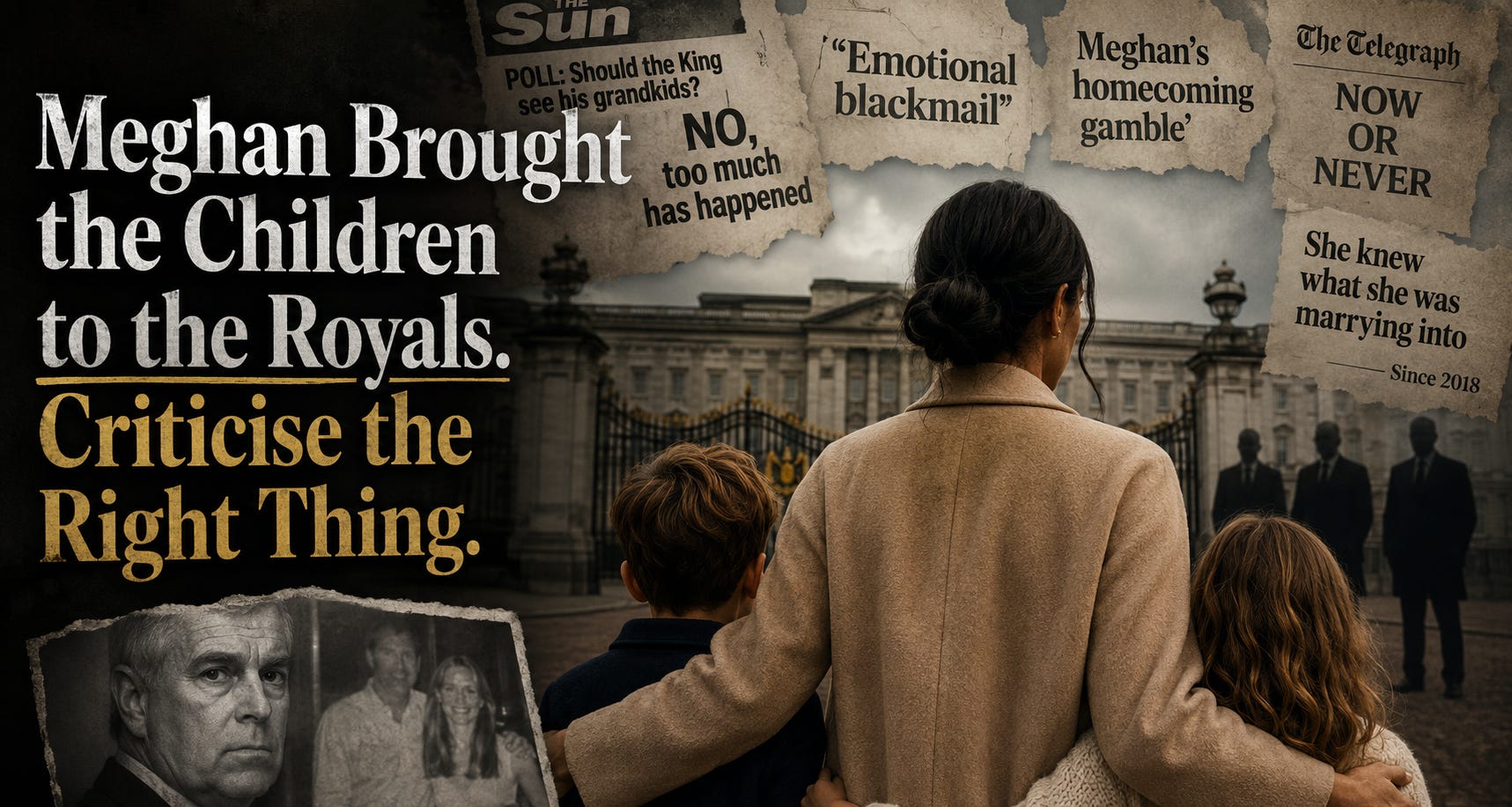
On Friday, at Highgrove, Archie and Lilibet met their grandfather for the first time in four years. Within hours the British press did what it always does.
For those of you who are new to my column, I write about how child sexual abuse hides behind normality, professionalism, and the reassurance of respectable institutions, and today I want to talk about what these headlines are built to make you miss.
Awareness changes outcomes. Subscribe before hindsight does it for you, its free.
The Sun ran a reader poll asking whether the King should even see his own grandchildren. The winning answer was “No, too much has happened.” One outlet called the visit “emotional blackmail.” Another called it Meghan’s “homecoming gamble.” The Telegraph made it “now or never.”
And underneath all of it sat the line they’ve run since 2018, the one that never dies:
She knew what she was marrying into.
That’s the criticism. Vanity. Overreach. A woman who left, and now thinks she can come back. Every word of it is a magic trick, because it points your eyes at her manners and away from the family she walked into.
They’ve hinted at the trick themselves. In their Netflix series, Harry called the machinery of leaking and planting stories a “dirty game.” Meghan said she wasn’t thrown to the wolves, she was fed to them. Their lawyer, Jenny Afia, told the same series she’d seen evidence of negative briefing from the palace against the couple, “to suit other people’s agendas.” Whose agendas, they didn’t spell out. But you don’t have to squint hard. A duchess who crossed her legs the wrong way is a tidy scandal. It fills a front page. It fills a week. And a week spent litigating Meghan’s manners is a week nobody spends on the prince down the hall, and on what he’s alleged to have done.
So let me point your eyes back.
Andrew Mountbatten-Windsor, the man once known as Prince Andrew, was accused by Virginia Giuffre of sexually abusing her when she was 17, after Jeffrey Epstein trafficked her. He denied it. In 2022 he settled her civil claim for an undisclosed sum and a donation to her charity, with no admission of liability. In her memoir, published posthumously last October, Giuffre alleged that one of those encounters was part of an orgy involving around eight other girls, who she said appeared to be under eighteen and mostly didn’t speak English. Those are her allegations, in her own words, in a book she asked to be published after her death. In February this year, Andrew was arrested on suspicion of misconduct in public office. He has since been stripped of his titles and moved off the royal estate.
One share. One parent. One child safer.
For years, the people around him closed ranks. That part isn’t a theory, it’s on the public record. In January 2015, days after Giuffre’s allegations landed in court filings, Andrew’s ex-wife Sarah Ferguson went on American television and called those allegations “salacious lies” and “defamation of character.” She called him “one of the greatest men I’ve ever met in my life.” She said her reaction to a 17 year old’s account of being trafficked was “total fury.” She was later dropped by one charity after another when a separate email surfaced in which she’d called Epstein her “supreme friend.” That’s what closing ranks looks like. The stonewalling, the loyal royal on daytime TV branding the girl a liar, the quiet keeping of a home and a title long after the photograph of a grown prince with his arm round a teenager had gone round the world.
So criticise Meghan if you want. But criticise her for the right thing. Not for leaving. Not for coming back.
The right question is blunter than any of them will print:
Why the f*%$ would you let your children anywhere near a family that protected a man that long, against allegations like those?
And here’s the part the coverage keeps burying. Harry and Meghan have spent years refusing to bring these children to Britain at all. They’ve cited security. They’ve hidden the kids’ faces in every photo they post. They wouldn’t come without the protection they said they needed, and when they finally did come, it was one controlled afternoon and no cameras. Read one way, that’s a difficult couple. Read another way, that’s two parents doing the exact thing I have spent the last several years begging parents to do. They kept their kids at a distance from a situation they couldn’t control.
Call it a security dispute if you like. I’d call it protective insight.
None of us walked in knowing the history. That’s the thing the “she knew what she was marrying into” crowd can’t admit. No one knew, not really, not until Epstein’s world cracked open and the names started falling out of it.
You can’t blame a person for walking into that and then wanting to get their children the hell out of reach. That isn’t a scandal. That’s a responsible parent.
Would you take your daughter to meet them? Would you fly her to the other side of the world for the photo? Would you hand your child to the warm side of a family, knowing what sat on the other side of it, and knowing exactly how long they let it sit there?
If someone in your own family stood accused of what Andrew stood accused of, if your protective and insightful you wouldn’t be planning a reunion.
You’d be planning the distance.
That’s the story. The rest is misdirection.
Note: This article is not a criticism of Meghan for bringing the children to see their extended family. From the outside, it appears the visit was handled cautiously, privately, and in a way that prioritised the children’s safety. My criticism is directed at the tabloid coverage, which seems far more interested in judging Meghan’s decisions than asking harder questions about the family and institutions surrounding her.
Legal and Privacy Concerns. Under Australian privacy laws and for personal safety, the author uses a pseudonym and AI-altered imagery. While the author is a psychologist, the views expressed here are personal and do not constitute professional psychological advice or a clinical opinion.
Your voice belongs in this conversation.