

I write about protecting children, understanding trauma and finding a way forward. From the conversations that help children stay safe to the work of healing after trauma and the systems that must do better, I explore the things we need to understand, the questions we need to ask and the changes we need to make.
Subscribe to The Protective Insight for thoughtful, research-informed writing grounded in lived experience, psychological insight and a commitment to doing better.
I read it in Ubud. I received an email announcement earlier in the week and approached the upcoming release with hope. I missed the email on the release date. I’d spent the week at the Readers and Writers Festival expanding my literary knowledge and trying to reset my nervous system after three relentless years of managing the trauma of my child’s disclosures in childcare. I’d done meditations, a sound healing and, that morning, a breathwork session that left me feeling lighter than I had in years.
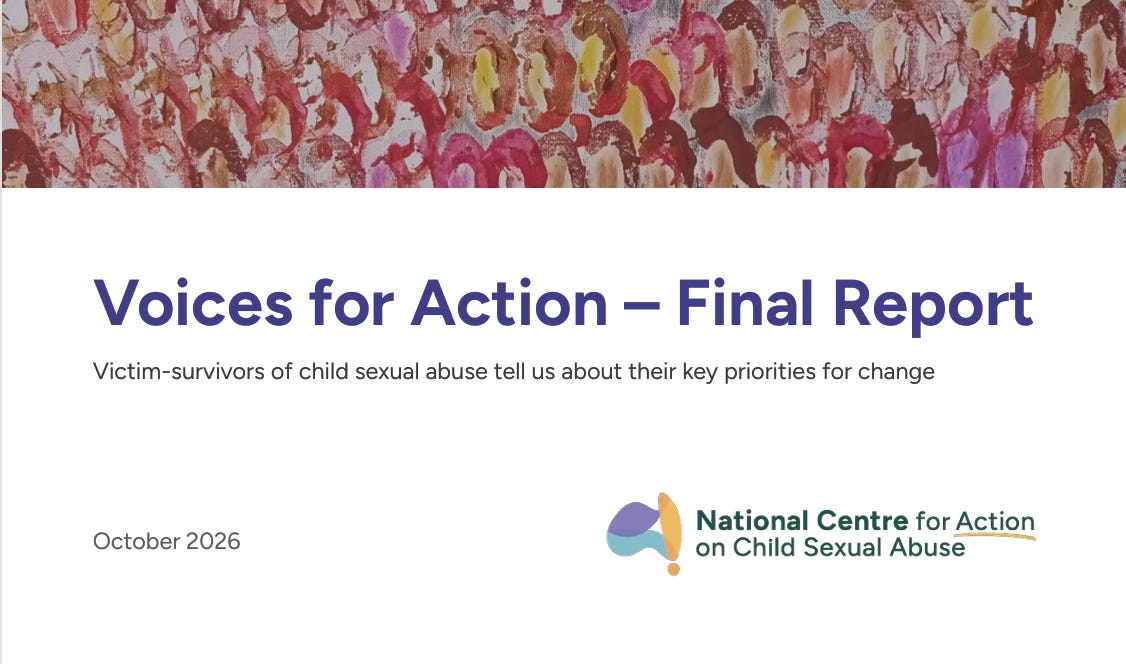
Then I sat down with the National Centre for Action on Child Sexual Abuse’s Voices for Action — Final Report. I read the content warning. I know what’s in these documents. I’ve read many survivor stories, and I was prepared for the material.
What I did not anticipate, was how I would feel by page twenty. Sitting in a garden in Bali, I was frustrated, feeling dismissed and a little hopeless. It was a familiar feeling: the sense that institutions were asking people to be quiet again, only this time it was coming from the very organisation meant to act on child sexual abuse and give victim-survivors a voice. The superficiality of the report and the Bali heat smothered me.
What the national report counts
Voices for Action gathered 84 submissions from adult victim-survivors through an online portal over six months. Two staff members read the submissions and grouped them into themes. A lot of care appears to have gone into the report, and some of the survivors’ writing, poetry and art are extraordinary.
I read the report quickly, then reread it, thinking maybe I missed something. I started searching the document for the words that tell us something about where its attention lies. Healing appears 53 times. Perpetrator appears six. Prosecution and sentencing don’t appear at all. When the report discusses missed opportunities to prevent abuse, it says they “are often missed or ignored.”
I was left wondering: ignored by whom? Some of the survivor submissions provided those details, they were just not captured by the report.
Language is critical. If opportunities to prevent and respond to abuse are being missed, we need to know where the failures occur, who is responsible and what needs to change.
The settings we don’t hear about
Search the report for childcare. The word isn’t there.
This is the year after a Melbourne educator who had worked across 23 centres was sent to the County Court facing more than 150 charges, after the parents of around 2,000 children were advised to have them tested for infection. In NSW, an educator was charged with 329 offences relating to more than 130 children across 62 centres, spanning 2009 to 2025. These are allegations, and the courts will determine the cases.
A national report on child sexual abuse doesn’t have to cover every case. But when childcare is the setting at the centre of such prominent cases, its complete absence raises questions about what the consultation captured.
The same goes for foster care, out-of-home care and the Family Court. These settings aren’t named either. Custody appears in one line, without any discussion of children whose disclosures may be interpreted as coaching, or of protective parents who say they have lost care of their children after raising concerns about abuse.
These are complicated issues, and they deserve careful treatment.
Who could take part?
The report’s methodology matters because it shapes whose experiences can be included. Good research starts with its design. When that design has limitations, acknowledging them in a brief line is not enough; those limitations need to be considered in the analysis and reflected rigourously in the findings.
A toddler cannot log into a portal and explain what has happened to them, they can barely put together a full sentence. A child in state care may face barriers to speaking freely. A child involved in Family Court proceedings may be subject to restrictions on what they can discuss publicly. Children with developmental or communication difficulties may have experiences that are difficult to put into words, even when they are trying to communicate something important.
Their experiences are not necessarily absent from every adult’s account. But a consultation that relies on people making submissions themselves is unlikely to capture the full picture of what is happening to children who cannot participate in that way.
I made a submission about children in childcare, focusing particularly about my son. I selected the categories for marginalised groups and people with disability. I was trying to draw attention to children who may not have the language or developmental capacity to explain their experiences, and who can be especially vulnerable because of that.
The report acknowledges that it couldn’t include every story. That’s a reasonable limitation for a consultation. My concern is about what is going to happen with these inherently limited findings. The report is intended to inform the Centre’s input to the Second Action Plan under the National Strategy.
Accoring to their website, this was a national call to action – a once in a generation opportunity to reshape the conversation on child sexual abuse. A big marketing claim, and it seems like a real missed opportunity.
What another report did better
Bravehearts’ Abbey’s Project, its 2016 report on the family law system, took a different approach. Developed with private funding and led by a parent whose child had been abused, it used case studies centred on children, identified institutional failures and made 30 recommendations, including recorded interviews conducted by trained child forensic interviewers.
The report made the children and the systems around them visible. It did more than describe experiences; it set out recommendations that could be considered and tested.
Bravehearts has also spent the past year advocating before a Victorian parliamentary inquiry for changes to early learning oversight, including unannounced inspections, published breach data and meaningful sanctions for operators. Concerns about childcare have surfaced in high-profile cases and in Queensland’s In Plain Sight report in 2025. The issues are being raised elsewhere. They are simply difficult to find in Voices for Action.
A report focused on lived experience should be allowed to focus on lived experience. But we need to be careful about what we ask that evidence to do, particularly when the people most at risk may not be able to contribute to it directly.
What counts as action?
If Voices for Action is informing the next National Strategy Action Plan, we should be asking more than whether survivors were given an opportunity to speak. We should be asking whether the consultation captured the settings in which children are being harmed, the institutions responsible for their care, and the barriers that prevent them from being heard.
A consultation cannot include every experience. But its limitations matter, particularly when its findings are used to shape national priorities. We need to seriously examine where the evidence falls short and seek out the information its consultation could not capture.
Listen to the voices that reach us and take responsibility for the children whose voices don’t.
I’ll keep talking.
If these are conversations you think we need to have,
subscribe to The Protective Insight.
Legal and Privacy Concerns. Under Australian privacy laws and for personal safety, the author uses a pseudonym and AI-altered imagery. This work features literary and reflective essays expressing a subjective lived experience; it is not a legal or investigative record. All references to harm or conduct reflect the author’s honest opinion and personal interpretation of events. Regarding the matters referenced, police investigations resulted in a finding of no offence detected; this work is an exploration of the psychological interpretations and healing that follow such experiences. While the author is a psychologist, the views expressed here are personal and do not constitute professional psychological advice or a clinical opinion.
A note on AI: I sometimes use AI to help refine my writing, but the experiences, research, perspectives and arguments are my own.
Sources:
National Centre for Action on Child Sexual Abuse, Voices for Action – Final Report (October 2026), pp. 8–9, 21, 40, 42 and endnote 2;
Bravehearts Foundation, Abbey’s Project: A Bravehearts Paper on the Family Law System (2016), Recommendation 3;
Bravehearts Foundation, submission to the Victorian Parliament Select Committee Inquiry into the Early Childhood Education and Care Sector (28 November 2025) and hearing evidence (11 March 2026);
Victoria Police and County Court of Victoria proceedings reported by The Nightly/AAP, 28 May 2026;
NSW proceedings reported by ACM/Illawarra Mercury, 13 July 2026.
Your voice belongs in this conversation.