

The walk
Karyann Parkinson let her five-year-old son walk 800 metres — half a mile — to a pond to collect goose feathers.
That is what she was convicted over in late August.
The walk was along a footpath in a gated community in Williamsburg, Virginia, separated from the road by about ten feet of grass, with a security post staffed around the clock. Sam had to cross two streets, both at marked crossings. He had already made the walk six times that morning, with his mother, on his bike, feathers sticking out of his backpack. Parkinson was eight months pregnant with her fifth child and making his lunch when he asked to go back for more.
A passer-by called security. A guard walked him home and told him that bad people would have taken him.
At trial the guard testified against her, along with his boss and the police. The child protection worker who attended said Sam appeared happy and healthy when she saw him that day.
Parkinson now has a Class 1 misdemeanour conviction for contributing to the delinquency of a minor, a charge generally associated with teenagers rather than a five-year-old walking to a pond. She received a six-month suspended jail sentence and seven years on Virginia’s child abuse and neglect registry. An appeal is listed for February next year.
I know that I would not have been a parent who said yes to that. I wouldn’t. Absolutely no way. If my five-year-old had asked to walk 800 metres on his own I would have had a list of reasons why not, and I would have delivered every one of them, and there is no way he would have gone.
But I am still outraged that this is where the line landed.
Both of those things are true at the same time and I am not going to reconcile them. I will never let my child do it. I also don’t accept that a child walking 800 metres inside a gated community is a child abuse matter, or that a woman should carry seven years on a registry for it.
What I’m holding onto is an ideal. That the world should be safe enough for a five-year-old to walk to a pond, collect feathers and come home.
I know exactly how not-safe it is yet I still want it to be. If Sam had gone into that pond, every one of us would be looking at this story differently. We would be asking what kind of mother lets a five-year-old walk away from home alone.
I know that to be true, but its not the only parenting story we need to assess this month.
Where we draw the line
Protective insight is noticing a pattern, or a harm, and then deciding to act on it. Both parts. Noticing on its own is just watching.
I spent a long time doing only the first part. I saw things and filed them away. I told myself I’d wait and see, that someone better placed would deal with it, that I might have it wrong. I did not always have it wrong.
That is most of the reason I write. Not to be the person who noticed — noticing is cheap and I have no shortage of it. To be one more reason somebody else does something about what they have already seen.
Systems have the same two parts, and the same failure sits between them. Parents. Courts. Police. The people who assess risk for a living. We probably like to think those thresholds sit roughly in line with our own instincts.
They don’t always. And the gap determines what happens to children.
If this is the kind of thinking you want in your inbox, subscribe. It’s free.
What I see in my work
Alongside the writing, I work as an expert witness in family law matters. I’m a psychologist. I write reports. I sit in the chair where two parents’ capacity is assessed against a child’s needs and circumstances and the whole thing is reduced to findings, and those findings change how many nights a child stays with one parent, and who gets to make decisions for them.
I can’t tell you about particular cases. I have confidentiality obligations as a psychologist, and family law proceedings are not publishable — it is an offence to publish an account that identifies a party, a witness or a child, and even a de-identified story becomes a problem once there is enough detail for someone to work out who I’m talking about.
On a general note, I have seen parents lose overnight time over the identity of an adult who was in the house and shouldn’t have been. I have seen shared care change because a parent could not demonstrate that they understood why something mattered.
I have also assessed a parent who worked in the sex industry. Their work was not an issue. It appeared in my findings only to say that they should not be judged for it, because it had no bearing on their child’s safety.
Capacity and insight is what we are assessing in those reports. Can this parent demonstrate appropriate parenting behaviours? Can they recognise a risk to their child and understand why it matters?
I have seen people lose custody for less than what I watched this week.
Hold that beside what follows. It is context for how thresholds get set.
Then there was Bonnie Blue
Bonnie Blue, whose real name is Tia Billinger, is 27. She announced the birth of her first child on 29 August with the caption and then there were 1058 of us, referring to the 1,057 men she said she slept with during a twelve-hour stunt in January 2025.
She has said she conceived at an event this February where she had unprotected sex with around 400 men, which she called a breeding mission, and that DNA was collected from the participants so paternity could be established if she became pregnant. As of June she said she did not know who the father was. Three men have publicly suggested they might be. No paternity result has been released.
Then, in the first week of September, she posted from hospital.
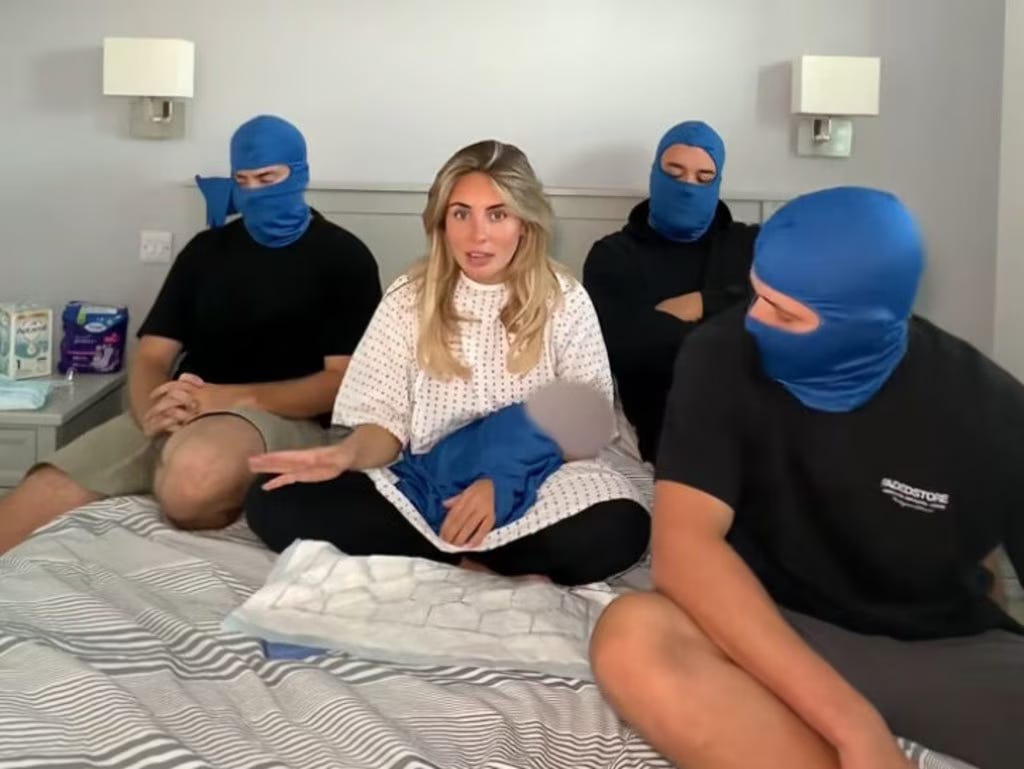
In the footage she is sitting on a bed in a gown holding an infant whose face has been blurred. Three men wearing blue balaclavas are standing around her. She talks about the six-week rule following a caesarean and makes sexual comments about being newly postpartum. In another clip she hands the baby across to the men while a lip-synced audio plays.
The footage does not show sexual activity or establish that adult content was filmed with the infant present.
There has also been speculation online that the baby is a doll. If it is a real infant, everything below applies. If it is an object made to look like her newborn, distributed to that audience, in that frame, it does not make the argument any better.
The blur
The baby’s face was blurred. Bonnie deciding to blur the face indicates she conducted a risk assessment. She looked at that frame, identified a child protection problem inside it, and solved for only one of the variables.
It just couldn’t extend as far as not discussing, while holding her newborn, the sex she says she had with the three men standing around the bed.
Who it was sent to
Think about the distribution list.
Not the general public. Not a parenting audience. That video went to a subscriber base assembled, at enormous scale and entirely on purpose, for one thing – arousal. That is what the account is for, that is what those people came for, and it is the frame of mind most of them are in when a notification arrives.
Into that, she sent a newborn in a matching blanket and a description of sex she says she had just had with the three men standing in the shot.
So think about one person on that list.
Not a monster. Not somebody on a register. An ordinary man who follows her for the reason most of them follow her. He opens the app at eleven at night, the way he has a hundred times before, and there she is on a hospital bed, talking about the three men around her and what she did with them.
He responds the way that account has spent years training him to respond. That is the business model. It is the whole reason he subscribed.
And there is a baby in the frame.
He did not go looking for that. Nobody asked him whether he wanted it there. It was placed inside the thing he was already doing, and now the two sit in the same memory, and he cannot take it back out.
There are men who have never once in their lives thought about a child in that context. This puts it in front of them anyway — inside her content, wrapped in innuendo, with the mother laughing.
And look at the platform. This is TikTok, where she advertises, where she recruits participants for her events, and where she sells. She has now put a newborn into that same pipeline. Once something is uploaded it is no longer within the control of the person who made it. It can be copied, shared or altered, at a time when AI-generated sexual material is not hypothetical.
A blurred face reduces the ability to identify a child. It does not remove the child from the material.
What it does to the rest of us
Grooming is a process rather than an event. It works by putting two things next to each other, over and over, until the pairing stops registering as strange. First the adult’s presence becomes ordinary. Then the contact. Then the secret. No single step looks like the thing it actually is, and that is precisely why it works.
The grooming process can be applied to both the child and the adults around them. A newborn has been placed within adult content and an audience is being invited to find it cheeky or provocative. Every person who watches it, reacts and scrolls on has had their threshold moved by a fraction, and the next one will have to go further for us to register that it is wrong. That is how grooming works.
I am not making a claim about what anyone intended. I don’t know what was intended. I am describing what the material does, which is a separate question, and the answer doesn’t change according to what was meant by it.
What I can tell you is what it did to me. I watched it and felt something shift that I did not consent to shifting. I have spent two decades learning to notice that feeling.
It is not okay.
Somebody did something
On 10 September, Joy Morrissey — the Conservative MP for Beaconsfield and shadow minister for women and equalities — wrote to the NSPCC to raise what she called serious safeguarding concerns.
Her letter says children are not adults. That they must never be involved in pornography, used to promote adult entertainment, or absorbed into a parent’s sexualised commercial brand. That even the suggestion a child might be placed in such circumstances is deeply disturbing.
It ends by saying that looking away is not an option.
That is the argument of this entire essay, made by a politician four days after the footage went up.
The NSPCC has confirmed it received the report and said it takes concerns about children’s safety seriously.
Blue’s answer was that the Conservatives are name-dropping her to stay relevant, that her baby is loved and protected, and that wasting the time of stretched services to score political points draws resources away from children who need them.
Who else is going to file?
A letter to a charity is not a finding, and the NSPCC is not a statutory authority. What Morrissey did was notice, and then do something. That is more than most of us manage but it is not a system response.
In family law, this kind of risk usually gets raised by the other parent. There is a dispute over where a child lives. Someone files an affidavit with their concerns. A court sees a family it would otherwise never have seen.
There is no other parent identified here. Apparently there are hundreds of possible fathers and no confirmed one. No affidavit, no application, no expert appointed to assess the child’s circumstances.
So the mechanism that normally puts eyes on a very young child does not exist in this case, and what we have instead is an entirely public situation, a mother making it more public by the day, and a British MP doing the her job.
One share. One parent. One child safer.
What I mean by protective insight
I am not offering a professional opinion on Bonnie Blue. I have not assessed her. I have never met her or her child. I have seen precisely what you have seen — clips on the internet — and nothing here is an expert opinion or should be read as one.
This is the opinion of a mother. A human being. Someone who spends her working life near child exploitation and trafficking, looking at this with her eyes wide open.
And in that capacity: I think what she is doing is flat out fucking horrendous.
I am not commenting on her capacity as a parent. I am not saying where that child should live. Removing a child from a mother is a grave intervention with harms of its own and it is not something one should propose from a laptop in Perth on the strength of a few clips.
I do know that child should not be on the internet like that. Protective insight is noticing the process while it is still running, and then doing something rather than watching.
It is in plain sight right now. That is the disturbing part.
I noticed. This is me doing the second part.
A tale of two mothers
Someone saw a five-year-old on a footpath and picked up the phone. I don’t accept what the system did next. But the noticing was right, and it cost that person nothing.
That is all protective insight is. A stranger deciding it isn’t their business to look away.
Thousands of people have watched Bonnie Blue’s video.
At least one of them wrote a letter.
Why I write under this name
I write as Hayley Jones. It isn’t the name I practise under, and that is deliberate — my son’s identity is not mine to spend, and the forensic work I do shouldn’t sit in a search result next to an essay about a stranger who makes adult content.
Nearly three years ago, my son disclosed sexual abuse at his childcare. The police investigation closed with no offence detected. Other children were named. Witnesses I considered critical were never interviewed.
That is why I write about thresholds. About the exact point where a system decides that what it is looking at counts as something, and about what happens to a child when it decides that it doesn’t.
Sources
Karyann Parkinson’s conviction, the circumstances of the walk, and the trial evidence:
-
Mom found guilty of abuse for letting 5-year-old walk outside alone speaks out — CBS News
-
Mom charged after 5-year-old walks to pond alone, stirring parenting debate — The Washington Post
-
Virginia mom gets 6-month suspended jail sentence for letting 5-year-old walk to the pond — Reason
The birth announcement, the caption, and the paternity question:
-
Bonnie Blue gives birth as ‘1,058 of us’ caption leaves father’s identity a mystery — International Business Times UK
Joy Morrissey’s letter, the NSPCC report, and Billinger’s response:
-
MP reports Bonnie Blue to NSPCC over safeguarding concerns — International Business Times UK
-
Bonnie Blue has been formally reported to the NSPCC for ‘deeply disturbing’ stunt posts with baby — The Tab
-
NSPCC shares statement following Bonnie Blue being reported for ‘serious safeguarding concerns’ — The Tab
Disclaimer
This piece is honest opinion based on matters already reported in the public domain, including the Virginia conviction of Karyann Parkinson and publicly circulated social media content and commentary concerning Tia Billinger (Bonnie Blue). No finding of criminal conduct or child abuse has been made against any person named here, and none is asserted, and nothing here should be read as an allegation that any criminal offence has been committed. My views about that material are expressed in a personal capacity as a parent and member of the public. They are not a professional assessment, not an expert opinion, and not an opinion about any person’s parenting capacity. My references to my own professional work are general, describe no identifiable person, case, child or proceeding, and are consistent with my confidentiality obligations as a registered psychologist. References to my family’s own experience reflect my account of it; the police investigation closed with no offence detected. Nothing here is clinical or legal advice.
This essay began as a dictated voice note, was edited with AI assistance, and was then revised line by line by me.
Your voice belongs in this conversation.