

There is a version of this story week that ends with another trauma trigger defining the week on Thursday night.
In that version of the week, a short protective behaviours session with my son turns into a conversation about childcare. He offers it casually, the way children always do it — mid-activity, half-distracted, as though he were telling me about a book character. I grimace somewhere behind my eyes and match his tone. Casual volley for casual volley. I intuitively know that the one thing I should not do is react.
I grab my phone, I hit record. I know I will not remember this accurately, and accuracy is the job now.
I record because my brain is doing what many people do in trauma, it is dissociating. Internally I scream, not here again as a piece fractures off and a small piece tries to hold details, emotions and keep track of the conversation.
He says what he needs to say, then drifts off, and I lie next to him in the dark with my eyes open, painstakingly waiting for him to be deeply asleep so I can leave the room, document and process.
That’s the part nobody warns you about. Not the how to respond to disclosures conversation. The pretending. Having to speak lightly when what you want to do is scream. Lying beside your child, timing your exit, then having to postpone your break down and rage so that you can be a witness and document the earlier part of the conversation that you did not record.
That task out of the way, I wait painfully for my husband to return. Then I stand in my kitchen and deliver the angry monologue. On childcare. On standards. On the useless pricks who hurt children, and the systems that hand them the keys and then act astonished. It is a very good monologue. It has range. It has an entirely fresh round of expletives and dramatic emphasis, and it is performed to my loyal audience of one husband as I pour a second glass of wine to wash down diazepam.
I unintentionally picked a fight with my husband over an issue that wasn’t really the root of our disagreement. The real issue was that our child continues to speak about the abuse that occurred in childcare, and it feels like there’s no justice for it. Years later, my son still brings me evidence that I document, but unfortunately, no one is legally obligated to take action on it.
That version of the week is true. It is just not how it finished.
There’s another version. It ends two nights later, in a park, under coloured light — and I only have it because of a woman I follow on Instagram.
Going with the flow of life
I’ve spent a career helping people understand that emotions are like the weather. You can’t reason a feeling into leaving, or outrun it, or even predict it too well with analysis. Sometimes you can only drop anchor and ride out the storm.
So the philosophy I try to embody when managing traum is simple. Enjoy what there is to enjoy and suffer what there is to suffer. When you’re down, be down. When you have to confront something, be with it. And when you’re up, be fully, unguardedly up.
This is what happened when I refused to let trauma, new disclosures and dissociation dictate my weekend.
Awareness changes outcomes.
Subscribe before hindsight does it for you, its free.
The call I almost cancelled
Friday morning, eleven o’clock. A Zoom with another advocate — a woman whose whole field is grooming. My fingers hovered over the keyboard when the confirmation email came in. Something’s come up. Can we reschedule?
Every reason to cancel was a good one. I was flat. I was raw. I had nothing to give anybody. It was too late to cancel. So I went.
We had forty-five minutes and we talked for ninety, which meant reconnecting to Zoom twice — two women trading the worst things they know, and then sorry, you dropped out, say that again. We told each other how we ended up doing this work. Her half of that is hers, and not mine to publish.
And somewhere in the middle of it, something lifted.
This is the part people outside this world find hardest to believe. There is a kind of connection available inside catastrophe that isn’t available anywhere else. No preamble. No performance. No explaining why you’re protective. You meet someone who already knows the shape of it and you skip nine months of scaffolding a connection in the first four minutes.
Trauma isolates individuals. It convinces you that you are alone and should feel ashamed, feeding on your silence. However, when you find others who are experiencing the same pain, the very intensity that once isolated you can create a powerful bond at a pace that ordinary life often does not allow.
I disconnected from Zoom, lighter than I got on.
Self-care can mean taking time for meditation, a nap, or resting in a dark room, which I had done the night before because I really needed it. However, sometimes self-care means pushing through and attending the event you were about to cancel, because that experience is what sustains you.
I don’t know how to predice which one it will be, I just try and go with the flow of life. Suffer what there is to suffer and enjoy what there is to enjoy.
$167 and a two overpriced marshmallows
I booked Kings Park Lightscapes on the Saturday morning. An indulgence, and a decision — Thursday night was not going to take the weekend as well.
One hundred and sixty-seven dollars for a family of four, same-day. I checked the price twice and paid it.
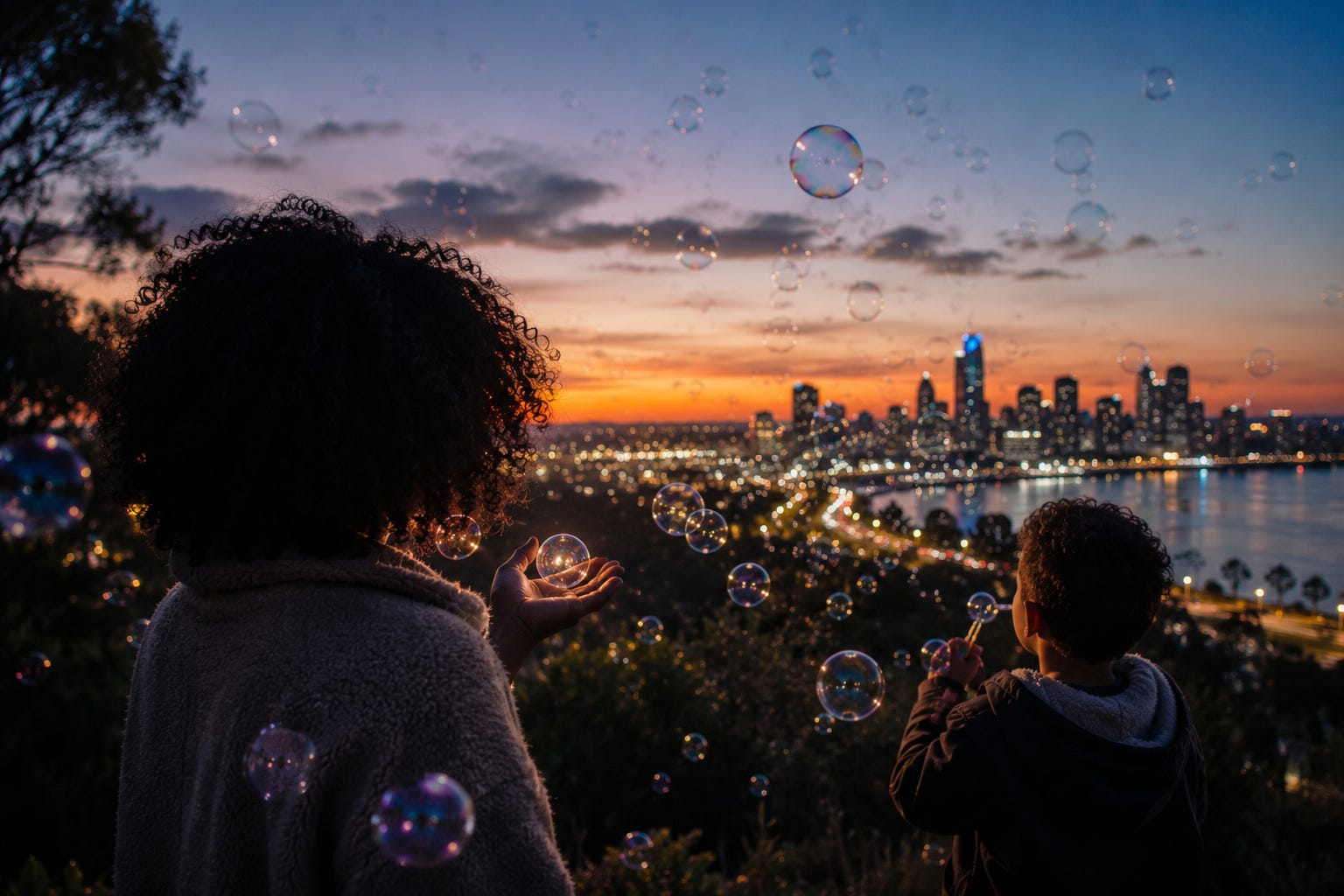
We went early. We blew bubbles out over the escarpment and watched them drift across the whole glittering city, the river behind it, my children shrieking at soap. We roasted marshmallows on sticks that cost more per unit than most of my groceries. We walked through the Aboriginal light art with our heads glued to the pictures alight and moving along the path, and I watched my son go quiet and loud in the best way. In awe of the pathway art.
I had champagne. I want to be accurate about this. I was not drunk on the champagne. I was drunk on the fact that we were there at all.
Then, we step outside the winter wonderland and then a song came on.
The Natasha Bedingfield one. The one about your life being a book that isn’t finished, about today being the page you’re standing on. It is, objectively, a 2004 pop song that has been used to sell everything from pantene to an MTV reality show.
They must play it at primary school too because my son recognised it.
He took my hands and we danced. Under the lights, in a public park, in front of Perth and several hundred strangers. He kissed me on the cheek mid-spin. We’d already danced through three or four songs, but that one landed differently — because days earlier we had been sitting with things no child should have to carry, and here he was, spinning me under coloured light, we were entirely in this moment. He was entirely inside his own joy.
Nothing had been resolved. The investigation was still closed. The system was still the system.
It was still the best night we’d had in a year.
Thirty times
That night, going to sleep, he said it.
Today was the best, best, best, best, best — Thirty times. I counted. I actually lay there in the dark counting, thinking: remember this, remember this..
And then he landed it. And the GOODest day ever.
Goodest. Not a word but the only correct word.
Glimmers
So back to the woman who inspired me, there’s a researcher here in Perth I follow, Dr Jen Achari, and a few weeks ago she wrote something that shapes how I understand my own night.
Her PhD is in trauma-informed education. She was a head of school and a deputy principal before this. Her work asks how individuals and systems create what she calls the conditions for hope — the safety, attachment and regulation a nervous system needs before it will settle.
Her subject was glimmers. The opposite of triggers. The term comes out of Deb Dana’s polyvagal work they are micro-moments that cue your nervous system toward safety instead of threat. Not life highlights, just ordinary things, made significant by the act of noticing them. Jen’s list this week was a coffee, walking into a job she loves, flowers waiting for her when she got home from Vietnam, slow time with her family, winter sun.
None of it extraordinary. All of it everything.
And her line is one I keep returning to: “the good stuff waits to be collected”.
Your brain will find the threat on its own. It is built for that. It does not need your help, and after what my family has been through mine finds threat in a car park, a staff roster, a man being friendly to my son at a birthday party. That system runs unsupervised, twenty-four hours a day.
The good has to be observed and collected, intentionally, every week.
Which changes what actually happened at Kings Park — because it would be easy to file that night as a highlight-reel moment. The expensive tickets. The installations. The pop song. It wasn’t that. The $167 bought the container. The glimmers were free, and small, and I could have missed every one of them.
I took photos of soap bubbles going out over the escarpment, catching the city lights on the way down. They were ‘unpoppable’ bubbles so I captured some on my fingertips and fanned them out as I sipped my champagne. I documented the kiss on the cheek, mid-spin. My son’s head leaning forward in front of the light art. Hundreds and thousands melting into overpriced marshmallows that light up two children’s faces over a camp fire. The word Goodest.
That’s the collection. Not the event — the forty five minutes inside the event where my nervous system, which has spent years scanning for the next thing, embraced the joy of being alive.
I only have them because I was looking.
What I actually mean by following the light
Following the light is not looking on the bright side. It is not gratitude practice. It is not the suggestion that joy heals trauma.
Following the light means refusing to let the worst thing that happened to your family take over the rest of the week.
It means moving with the rhythm of life instead of bracing against it. Down when it’s down. Rest when it’s rest. Push when it’s push. And when Kingspark Lightscape comes — at $167 a ticket, in a park, halfway through a pop song — you go all the way in. You dance badly. You buy the overpriced marshmallows.
Because my son is going to remember something about this period of his life. He is going to remember that he told the truth and the adults listened to him. And I would like him to also remember that in the same week, his mother spun him under the lights until he ran out of ways to say best.
So I’ll ask what Jen asks, because it’s the right question and I don’t think most of us have an answer ready.
What did your ordinary week quietly hand you?
Not the achievement. Not the milestone. The four minutes you almost walked past.
Go back and get it. Write it down. I’m going to keep collecting mine — the bubbles, the kiss, the wrong words that are the right words — for as long as this takes.
One share. One parent. One child safer.
Legal and Privacy Concerns. Under Australian privacy laws and for personal safety, the author uses a pseudonym and AI-altered imagery. This work features literary and reflective essays expressing a subjective lived experience; it is not a legal or investigative record. All references to harm or conduct reflect the author’s honest opinion and personal interpretation of events. Regarding the matters referenced, police investigations resulted in a finding of no offence detected; this work is an exploration of the psychological interpretations and healing that follow such experiences. While the author is a psychologist, the views expressed here are personal and do not constitute professional psychological advice or a clinical opinion.
This essay began as a dictated personal account. I transcribed it, used AI as an editorial tool to help shape structure and wording, and then revised it extensively line by line until it reflected my own voice and intended meaning.
Your voice belongs in this conversation.