
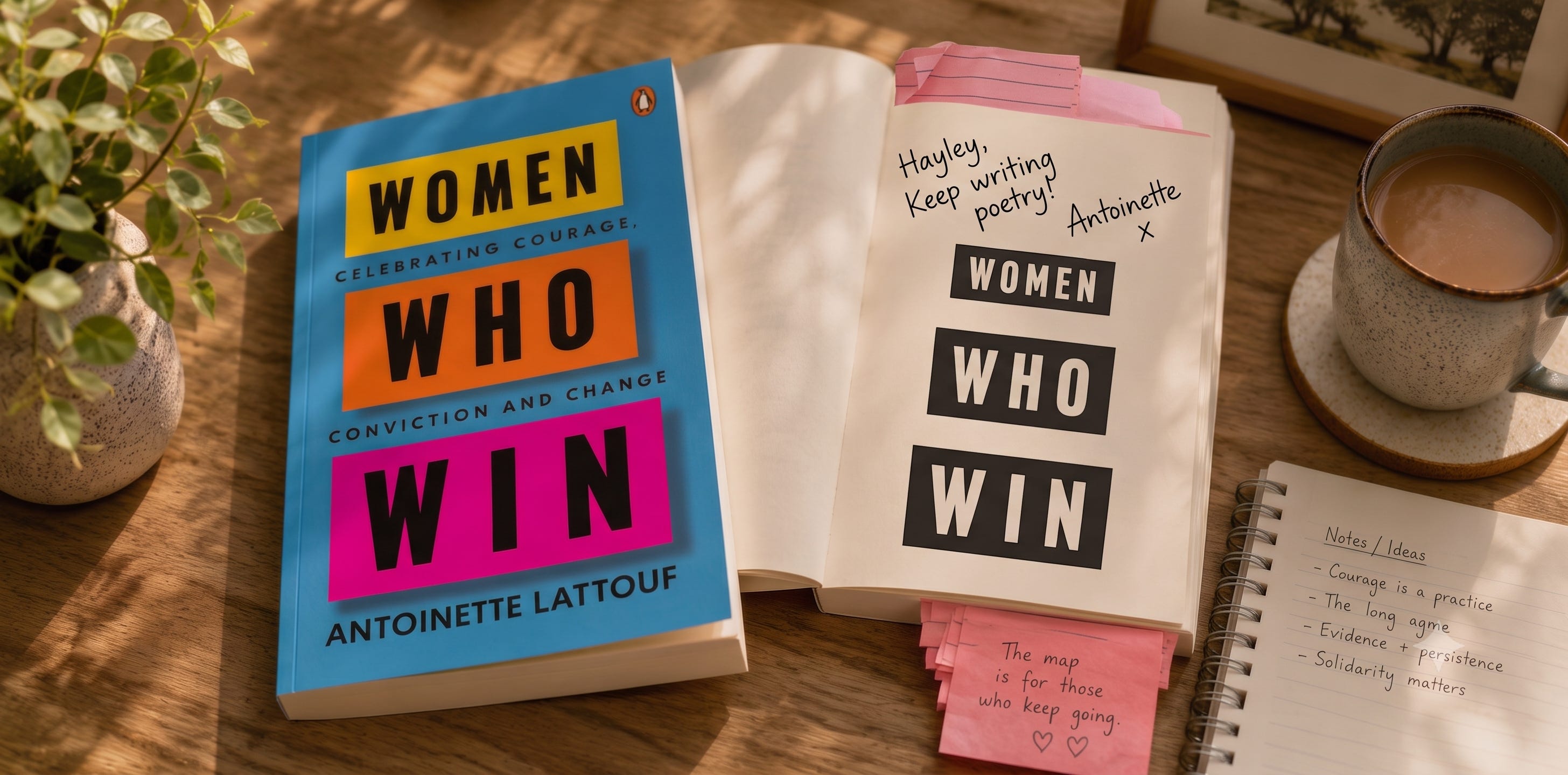
I met Antoinette in October 2025, in the middle of my daycare advocacy crisis. She took me under her wing at the Ubud Writers and Readers Festival, exclusive parties and all, and I supported the launch of her sold-out Perth book tour soon after. About a month ago she asked whether I would write a review of her book. I said yes, and then I went quiet, and she has probably been wondering why I have been dragging my feet. What she did not know is that I was compiling something closer to a novel. I don’t like to do things in quarters.
Women Who Win is Antoinette Lattouf’s book about Australian women who confronted injustice and won, from colonial-era First Nations resisters to present-day climate and courtroom fights. Its first chapter, “Unapologetically Outlaw,” honours First Nations women, and Lattouf’s own win against the ABC runs through the whole book as a spine. This guide lists every woman I could identify in the book, more than forty in all, with a line on each, then draws out what they share about how to advocate. Among them are Antoinette Lattouf, Grace Tame, Vida Goldstein, Emma Miller, Ada Evans, Flos Greig, Ruby Payne-Scott, Fanny Durack, Judith Wright, Wendy McCarthy, Sarah Hanson-Young, Murrawah Maroochy Johnson, Gladys Elphick, the Fairlea Five and many more. If you came here for the full list, scroll to the roster. If you came to think about advocacy, start at the top.
I came to Antoinette Lattouf’s Women Who Win with one question. Not “who are these women,” but something more self-focused and useful: what can these women tell me about how I can be a better advocate. I work in child protection, where the wins are slow and the losses keep their own ledger, and I wanted to know what the women who actually shifted something had in common. I read the book with a highlighter and a notebook, replayed the audiobook clips over and over, and somewhere around the second review my notes stopped being a list of names and inspirational quotes and started being a method.
This piece is two things. It is the complete roster of the women Lattouf gathers, because if you have come here searching for the full list of women in Women Who Win, you should be able to find every one of them in the one place. And it is what they taught me, read together, about what advocacy actually is once you strip away the motivational poster version of it.
I am also writing it for the students and the advocates. Lattouf’s own legal case against the ABC is already studied in law schools, and a book that runs this deep through Australian women’s history, from colonial resistance to climate litigation, is the kind of text that ends up on school and university reading lists. So consider this a shortcut guide, the one I wish I had while reading: every woman in one place, with a line on why she matters, for the student writing the essay and the reader who wants the map before they commit to the territory.
A note on order, because Lattouf’s own choice matters. Her own case (spoiler alert: her win against the national broadcaster) is not a chapter that sits first. It runs through the whole book as a spine, surfacing in the opening and threading underneath everything that follows. The first chapter proper belongs to First Nations women, and she calls it “Unapologetically Outlaw.” She honours them first not as a courtesy and not as an acknowledgement tacked to the front of proceedings, but as the foundation the rest of the book stands on, the longest and most continuous tradition of resistance on this continent. I have kept that one act of order here, opening the roster with the First Nations women. Beyond that, the way I have grouped the women below is mine, sorted by the kind of fight they waged or the way they inspired me rather than by Lattouf’s chapters. This is my map of her book, not a copy of its contents.
I did not read this book as a bystander. I came to it from the middle of my own fight, the kind that does not make a tidy chapter with a verdict at the end. For years I have pushed against a particular absurdity, that the children least able to speak for themselves, the toddlers placed in daycare, are the ones whose words are the easiest to explain away. I have seen a small child’s disclosure filed under developmentally appropriate, as though a phrase could launder what a child had just said. I have watched evidence set aside, and been told, in effect, that raising the alarm was treated as the problem rather than the harm.
When I ran sessions teaching parents how to recognise the signs of abuse in toddlers, I was told the police were watching me. Sit with the shape of that. The person teaching others to notice harm, recast as the threat. Threats have not stayed in the realm of meetings and paperwork either. There have been threats, to me and to my child, and there are things my son has said that no parent should have to hold.
So when Lattouf writes about women called difficult and too much, about evidence dismissed and resolve that arrives late and bleary-eyed, it did not read to me as history. It read as a Tuesday.
Three years before my son was born, I watched something happen inside my profession that I could not look away from. Bob Montgomery, a former president of the Australian Psychological Society, was convicted of child sexual offences in 2020. What stayed with me even more than the conviction was the institutional response. When the APS emailed members about the case, the focus was on the impact on Montgomery and his family. Victims were not mentioned. Hundreds of psychologists complained.
That was the moment I understood that institutional protection of child abusers was not an American phenomenon or an Epstein problem. It was here. It could happen inside respected professions and trusted organisations. Once you see that, you cannot unsee it.
The women in Lattouf’s book gave me a framework for understanding what comes next: what it means to keep pushing when institutions would prefer you stayed quiet.
These women gave me a framework for what I was already living.
One share. One parent. One child safer.
The short version. Women Who Win is Antoinette Lattouf’s book about Australian women who confronted injustice and won, from colonial-era First Nations resisters to present-day climate and courtroom fights. Its first chapter, “Unapologetically Outlaw,” honours First Nations women, and Lattouf’s own win against the ABC runs through the whole book as a spine. This guide lists every woman I could identify in the book, more than forty in all, with a line on each, then draws out what they share about how to advocate. Among them are Antoinette Lattouf, Grace Tame, Vida Goldstein, Emma Miller, Ada Evans, Flos Greig, Ruby Payne-Scott, Fanny Durack, Judith Wright, Wendy McCarthy, Sarah Hanson-Young, Murrawah Maroochy Johnson, Gladys Elphick, the Fairlea Five and many more. If you came here for the full list, scroll to the roster. If you came to think about advocacy, start at the top.
I came to Antoinette Lattouf’s Women Who Win with one question. Not “who are these women,” but something more self-focused and useful: what can these women tell me about how I can be a better advocate. I work in child protection, where the wins are slow and the losses keep their own ledger, and I wanted to know what the women who actually shifted something had in common. I read the book with a highlighter and a notebook, replayed the audiobook clips over and over, and somewhere around the second review my notes stopped being a list of names and inspirational quotes and started being a method.
This piece is two things. It is the complete roster of the women Lattouf gathers, because if you have come here searching for the full list of women in Women Who Win, you should be able to find every one of them in the one place. And it is what they taught me, read together, about what advocacy actually is once you strip away the motivational poster version of it.
I am also writing it for the students and the advocates. Lattouf’s own legal case against the ABC is already studied in law schools, and a book that runs this deep through Australian women’s history, from colonial resistance to climate litigation, is the kind of text that ends up on school and university reading lists. So consider this a shortcut guide, the one I wish I had while reading: every woman in one place, with a line on why she matters, for the student writing the essay and the reader who wants the map before they commit to the territory.
A note on order, because Lattouf’s own choice matters. Her own case (spoiler alert: her win against the national broadcaster) is not a chapter that sits first. It runs through the whole book as a spine, surfacing in the opening and threading underneath everything that follows. The first chapter proper belongs to First Nations women, and she calls it “Unapologetically Outlaw.” She honours them first not as a courtesy and not as an acknowledgement tacked to the front of proceedings, but as the foundation the rest of the book stands on, the longest and most continuous tradition of resistance on this continent. I have kept that one act of order here, opening the roster with the First Nations women. Beyond that, the way I have grouped the women below is mine, sorted by the kind of fight they waged or the way they inspired me rather than by Lattouf’s chapters. This is my map of her book, not a copy of its contents.
I did not read this book as a bystander. I came to it from the middle of my own fight, the kind that does not make a tidy chapter with a verdict at the end. For years I have pushed against a particular absurdity, that the children least able to speak for themselves, the toddlers placed in daycare, are the ones whose words are the easiest to explain away. I have seen a small child’s disclosure filed under developmentally appropriate, as though a phrase could launder what a child had just said. I have watched evidence set aside, and been told, in effect, that raising the alarm was treated as the problem rather than the harm.
When I ran sessions teaching parents how to recognise the signs of abuse in toddlers, I was told the police were watching me. Sit with the shape of that. The person teaching others to notice harm, recast as the threat. Threats have not stayed in the realm of meetings and paperwork either. There have been threats, to me and to my child, and there are things my son has said that no parent should have to hold.
So when Lattouf writes about women called difficult and too much, about evidence dismissed and resolve that arrives late and bleary-eyed, it did not read to me as history. It read as a Tuesday.
The whisper had started years before any of this. Three years before my son was born, I watched something happen inside my profession that I could not look away from. Bob Montgomery, former president of the Australian Psychological Society and head of psychology at Bond University, was convicted of child sexual offences in 2020 and sentenced to four years in prison. He had spent years preparing Family Court reports assessing whether children’s abuse disclosures were credible, and conducting risk assessments of paedophiles for the Queensland Government, commissioned more than twenty times and paid almost $70,000 for the privilege. He had been recruited to Bond University by criminologist Paul Wilson, who was himself later convicted of child sex offences and who in 1981 had published a book arguing there should be no age of consent for relationships between men and boys. When Montgomery pleaded guilty, the APS president emailed members to say the organisation wished “to acknowledge the impact of current proceedings on him and his family’s mental health” and hoped they were “seeking support from these friends through this process.” Victims were not mentioned. The APS was flooded with hundreds of complaints from its own members. That was the moment I understood that institutional protection of child abusers was not an American phenomenon, not an Epstein Island problem. It was here. It was inside a profession I had trusted. And once you have seen that, you cannot unsee it.
These women gave me a framework for what I was already living.
What advocacy actually looks like, according to these women
The first thing the book taught me is that advocacy is mostly persistence, and the persistence is longer than anyone tells you. Dr Janice Duffy spent twelve years and three Supreme Court trials, much of it representing herself, to make Google answer a defamation case for what its search results did to her name. Slobodanka Joncevska and the migrant women of the Jobs for Women campaign fought BHP for fourteen years before they won. Ada Evans graduated in law in 1902 and was not permitted to practise for nineteen years. None of these are stories of a single brave moment. They are stories of women who simply did not stop, long after stopping would have been reasonable.
The second thing is that advocacy often runs straight through a courtroom, and some of the cases that look impossible from the outside are the ones needed to forge new law and lasting change. Sandra Onus and Christina Frankland had to win the right just to be heard before they could protect their Country. Anjali Sharma was sixteen when she argued that a federal minister owed children a duty of care on climate. Sarah Hanson-Young, Jasmin Newman and Justice Dina Yehia each show a different face of the law as a tool: defending your own name, defending another woman’s, and changing how the courts weigh a person’s disadvantage when they sentence them. Lattouf’s own win against the ABC is the spine the whole book hangs from. The lesson is not that the law is fair. The lesson is that women have used it anyway, often when it was built to exclude them.
To be a great advocate you must be willing to be arrested, and to be called hysterical for it. The Fairlea Five, five Save Our Sons mothers, were jailed over Easter in 1971 for handing out anti-conscription leaflets, and the jailing turned an unknown movement into a national cause. Laura Davy was jailed in 2024 for chaining herself to a coal loader, then had the sentence overturned on appeal. Jo Vallentine was arrested marching on Pine Gap. Emma Miller led thousands of women through police lines on Black Friday. These women understood that the cost of the action was part of the action, and they paid it on purpose.
The fourth thing is that nobody wins alone, and that isolation is the thing the system relies on. The pattern underneath almost every story is women building structures to hold each other. Gladys Elphick founded the first all-Aboriginal women’s organisation in the country, and out of it grew a medical service, a legal service and a college. Vida Goldstein and Emma Miller built the Women’s Peace Army. Wendy McCarthy co-founded the Women’s Electoral Lobby and chaired the alliance that decriminalised abortion in New South Wales; she invites women to her porch for tea as part of her ongoing dedication to supporting other advocates. Slobodanka Joncevska had the other Jobs for Women plaintiffs beside her, and the Fairlea Five had each other in the cell. Agency, as Lattouf puts it, gets smuggled between women, in whisper networks and in messages and in the breakdowns over hotel lobby snacks after a hard day in court.
The advocates who last are the ones who know that you cannot do it on your own.
The fifth thing follows from the fourth, and it is the one that really changed how I think about my own work. The most durable advocates measure the win not by what they reach but by who they bring with them. Cath Roberts, who built Australia’s Space Command after a career of being talked over in meetings, says success is counted in the women you pull up behind you. The book keeps proving her right. Murrawah Maroochy Johnson won her Land Court case and then passed the microphone to the witnesses, so their knowledge went on the record in their own names. Grace Tame and Malika Reese fought to change the law on naming, so that the survivors who came after them would not have to fight the same fight twice. That is a particular kind of victory, the kind that turns your own harm into a road for the next person, and it is the kind that makes a single battle count for more than its own outcome.
The sixth thing is that you will be criticised for your opinion, and the criticism is confirmation you are doing it right. If the path were easy, the change would already be there. Every woman in this book was called something: hysterical, radical, difficult, loud, opinionated, unstable, too much. Ruby Payne-Scott’s own boss wrote a memo describing her as a bit loud, possibly unstable, but worth watching. Emma Miller was lampooned in every newspaper in Brisbane. Anjali Sharma was a sixteen-year-old told she had no standing to question a minister. Antoinette Lattouf found her voice, and the institution she worked for showed her the door for using it. Wendy McCarthy borrowed the title of her own memoir from a protest song: don’t be too polite, girls, show a little fight. The criticism is not a sign you are wrong. It is a sign you have been heard, and that you are saying something the system would prefer you did not.
Lattouf’s own journey in this book is the clearest version of that lesson. She describes learning to stop shrinking, to take up space in the room, to say the thing plainly rather than managing other people’s discomfort with it. The women who shifted something were not the ones who found a polite way to raise the issue. They were the ones who made the issue impossible to ignore.
The seventh thing surprised me, and it is the one I keep returning to. Advocacy can be made of art. Judith Wright’s poetry was not separate from her twelve-year campaign to save the Great Barrier Reef, it was the engine of it. Johanna McBride turns peace activism into a women’s choir that has sung in the marble foyer of Parliament House. Malika Reese uses music and storytelling to carry what testimony alone cannot. For those of us who write, or who make things, this is permission and instruction at once: the work and the witness can be the same act.
And the last thing is that you need humour, and the darker the better. Antoinette’s humour is woven all through her story, in her witty and insightful observations of herself and of these women. At one point she renders the behaviour of ABC executives during the week at the centre of her court case as a set of Christmas carols, a compilation by “DJ Lattouf” assembled in the spirit of poetic irony. She reaches for satire to tell the story of a cruel courtroom saga, explaining that when an ordeal wounds your heart and insults your intelligence in equal measure, humour may be the only instrument that can slow your panicked breath. Grace Tame arrived at one interview in an oversized black t-shirt printed with the word allegedly, a tongue-in-cheek nod to the work she does, and peppered her answers with the same hedge, allegedly, in her opinion, in her honest opinion, calling life in the public eye bizarre and unnatural. Malika Reese’s own bio reads, I have been robbed, raped and run over, and Lattouf clearly relished that dark, unforgettable line and the unbreakable spirit behind it.
The full list of women in Women Who Win
The First Nations women
Fanny Balbuk Yooreel — a Whadjuk Noongar woman who, in 1800s Perth, tore down the colonial fences built across her path and picketed Parliament House to protest the theft of her land.
Walyer (Tarenorerer) — a Tasmanian resistance leader abducted and sold into servitude to sealers, who escaped and later returned to fight in the Black War. She became a formidable strategist, training her people in musket warfare and teaching them to exploit the tactical gap between a settler’s shot and their reload.
Mary Ann Bugg was a Worimi woman and one of Australia’s few documented female bushrangers, yet while history lionizes her husband, Captain Thunderbolt, it has largely erased her vital role. Her superior bushcraft and strategic intelligence networks were the true keys to his long evasion of the police.
Gladys Elphick — a Kaurna and Ngadjuri elder, “Aunty Glad,” who founded the Council of Aboriginal Women of South Australia, the first all-Aboriginal women’s organisation in the country, and seeded a medical service, a legal service and a college from it.
Sandra Onus and Christina Frankland — Gunditjmara women who took Onus v Alcoa to the High Court in 1981 and won the right to stand in court to protect Aboriginal relics, a landmark a decade before Mabo. Residents of Portland threatened them and threw rocks and bricks at them but they marched on.
Murrawah Maroochy Johnson — a Wirdi woman of the Birri Gubba Nation who led Youth Verdict’s Land Court case against Clive Palmer’s Waratah Coal, the first time an Australian court rejected a coal mine on climate and First Nations cultural grounds. She received the 2024 Goldman Environmental Prize.
Dr Alana Gall — a Truwulway woman protecting First Nations cultural medicines from biopiracy, advising the World Health Organization and the World Intellectual Property Organization on Indigenous traditional medicine.
The author whose case runs through the whole book
Antoinette Lattouf — the journalist whose win against the ABC, after she was removed over a Gaza human rights post, is the spine the book hangs from, surfacing in the opening and threading underneath every chapter rather than sitting in one. One woman against the national broadcaster, and a global conversation about power, prejudice and the price of integrity in the press.
Antionette’s Mother — when a church in her Palestinian home village was bombed she crawled through rubble to save survivors, cradling shrapnel-ridden children as she ran to hospitals. She lost a five year old boy and girl she desperately tried to save. She passed on courage, compassion and a sense that institutions and power must be challenged to Antionette.
The women who won in the courts
Ada Evans — the first woman in Australia to graduate in law, at the University of Sydney in 1902, barred from practising for nineteen years until she finally broke through in 1921.
Flos Greig — the first woman admitted to practise law in Australia, in Victoria in 1905, after she worked with the politician John Mackey to pass the enabling act that removed the bar.
Justice Dina Yehia — The first Arab Australian to be admitted to the Supreme Court of NSW. lead counsel in the High Court’s Bugmy case, which set the precedent that a background of deprivation must weigh in sentencing. With a dedication to First Nations Australians, she is transforming the system from within
Dr Janice Duffy — a health researcher who, largely self-represented, beat Google in three Supreme Court trials over the defamatory material its search results carried, establishing that a search engine can be a publisher.
Jasmin Newman — a family dispute practitioner who won her defamation case against Adam Whittington after he branded her falsely online, with the court ordering him to pay more than three hundred thousand dollars.
Sarah Hanson-Young — the Greens senator who refused to absorb a colleague’s public insult as the price of the job, and won her defamation case against former senator David Leyonhjelm all the way through the appeals.
The women who won the vote and the peace
Vida Goldstein — in 1903 the first woman in the British Empire to stand for a national parliament, a suffragist who became an uncompromising pacifist and co-founded the Women’s Peace Army to fight conscription in the First World War.
Emma Miller — “Mother Miller,” the grand old labour woman of Queensland, who won women the state vote in 1905, led women through police lines on Black Friday in 1912, and campaigned against conscription. She dedicated decades to advocacy.
The Fairlea Five — Jean McLean, Joan Coxsedge, Irene Miller, Chris Cathie and Jo Maclaine-Cross, Save Our Sons mothers jailed over Easter 1971 for handing out anti-conscription leaflets, whose imprisonment turned the movement into a national cause.
Jo Vallentine — a Perth peace activist who came up through the Vietnam Moratorium marches and became, by her own account, the first peace candidate elected to a national parliament, arrested marching on Pine Gap.
Johanna McBride — musical director of A Chorus of Women, the peace choir that sang into being in the marble foyer of Parliament House as the Iraq war was declared, and has used song as peace-making ever since.
Slobodanka Joncevska — a Macedonian migrant who, told she should stay home now that she was a mother, joined the Jobs for Women campaign (featuring a tent embassy) and fought BHP for fourteen years in Australia’s first successful class action and the largest and longest sex discrimination case in Australian history. Upon winning the right to work her and her allies faced sexual harassment that she accepted and left the fight for those women who came after her.
Robyn Murphy– working along Joncevska she was one of the central leaders and organisers of the historic Jobs for Women campaign. After the campaign won women the right to work in heavy industry, she went on to work as a steelworker herself for 30 years. Decades later, she directed the acclaimed 2020 documentary Women of Steel, which chronicles this 14-year legal and grassroots battle.
Jessica Miscamble — is a lawyer who transformed a passion project on menstrual leave into a national campaign for reproductive leave, challenging workplaces to acknowledge the realities of women’s bodies and the disproportionate burdens women carry because of reproductive health.
Wendy McCarthy — who in the 1970s was one of eighty women to sign a public advertisement declaring they had each had an illegal abortion, daring the police to charge them, and decades later chaired the alliance that decriminalised abortion in New South Wales. If we were to be governed by risk, these rules would never change.
Sara Shams — a Bangladesh-born pharmacist and advocate for culturally diverse people living with disability, awarded the Minister’s Multicultural Award at the 2024 Multicultural Queensland Awards.
The women who won in science, sport and the sky
Ruby Payne-Scott — the world’s first woman radio astronomer, who hid her marriage for six years to keep her job under the public service marriage bar, and told the chairman she owed him no apology when it was found out.
Cath Roberts — an aerospace engineer who could not be a pilot when she joined in 1983 because she was a woman, was ignored in meetings until a man echoed her, and became Australia’s first Defence Space Commander.
Fanny Durack — the first Australian woman to win Olympic gold, in 1912, after a public fight to overturn the rule that women could not compete in front of male spectators.
Ellie Cole — AAustralia’s most decorated female Paralympian, learned to swim after losing a leg at age three and went on to win seventeen Paralympic medals, but considers some of her greatest victories to be the moments she rose above adversity rather than those spent on the podium.
Lisa Sthalekar — Born in an orphanage in Pune and raised in Sydney, she became the first woman to achieve the one-day double of a thousand runs and a hundred wickets. A trailblazer for equity in the sport, she was instrumental in advocating for fair wages (cricket is the first sport in Australian history to adopt equal pay for male and female elite athletes), becoming the first female board member of the Australian Cricketers’ Association.
Dr Aish Ravi — a football coach and academic working on women’s leadership and gender equality in sport, founder of the Women’s Coaching Association. She pushed the AFL to update its code to call racism what it is not conduct unbecoming.
The women who won by speaking up
Grace Tame — an activist and relentless advocate for survivors of sexual assault. She won the 2021 Australian of the Year and overturned Tasmania’s gag law to provide the right of survivors to speak under their own names.
Elizabeth Barber — a convict aboard the First Fleet in 1788, who lived in an era when coarse language from women was considered a sign of moral decay that justified punishment. She famously told an officer he could “come and kiss her C[unt]” for he was nothing but a lousy rascal.
Malika Reese — Noted for her darkly unforgettable biography (I have been raped, robbed and runover).Wollongong’s 2025 Citizen of the Year, a survivor-advocate who fought to lift New South Wales name suppression so she could be publicly identified and her step fatherabuser named.
Anjali Sharma — the schoolgirl who became lead litigant in the climate duty of care case, won a world-first ruling at trial, and when it was overturned on appeal took the fight to parliament instead.
Laura Davy — a twenty-one-year-old climate activist who chained herself to a coal loader at the world’s largest coal port in 2024, was jailed under the new anti-protest laws, and had the harshest sentence of the campaign overturned on appeal. She described herself as terrified but ready.
Amal Naser — a Palestinian organiser and third-generation refugee, a human rights advocate trained in law, and the force behind the March for Humanity that brought hundreds of thousands across the Sydney Harbour Bridge.
Judith Wright — the poet who led the twelve-year campaign to save the Great Barrier Reef from drilling and mining, and whose verse was the engine of the fight, not separate from it.
Ita Buttrose — A media pioneer and the founding editor of Cleo and ITA magazines, she was the first woman to serve as editor-in-chief of Sydney’s Daily Telegraph and Sunday Telegraph. Appointed Chair of the Australian Broadcasting Corporation (ABC) in 2019, she served nearly five years. In 2013 she was named Australian of the year.
What it all comes to
Lattouf closes the book with an argument I keep returning to. Power, she writes, is not gifted. It is built brick by bloody brick, quietly, sometimes painfully, cemented with rejection letters and patronising dismissals and the one smug lawyer’s email you are still considering printing out and setting on fire. Agency is not handed down by decree. It is seized, and smuggled between women, and the challenge is never to be fearless. Fearlessness is for Instagram and for toddlers with no sense of danger. The challenge is to act anyway. Proudly. Honestly. Relentlessly.
That is what all of the women in this book have in common, across two centuries and every kind of fight. Not wealth, not connections, not a blazing fury, though a little simmering resolve never hurts. They were called opinionated and difficult and too much, and they took the labels as armour and kept going. The path was hard because the change was worth having. That is the only reason it ever is.
I came looking for a method and I found one. Persist past the point of reason. Use the courts even when they were built against you. Be willing to pay the cost of the action. Build the thing that holds the next woman, and count your success by the women you pull up behind you. Let the poem and the song do work the affidavit cannot. Find your voice and use it at full volume, even when, especially when, the room would prefer you did not. Make bad jokes. And refuse to be moved and willing to be arrested.
This piece was the study. I read these women for their patterns, the persistence and the lawsuits and the protests and the choirs and the refusal to be polite, because I came to the book asking how to advocate better. The patterns are theirs. The next question is the harder one, and it is mine to answer in the open: what is the shape of my own? Which lever is mine by temperament, which one I have been avoiding, who am I pulling up behind me, and which of the labels I have been handed am I ready to wear as armour.
That is the next essay. Call it an advocacy map.
If you have ever been called opinionated, difficult, too much, you might want to draw yours alongside me.
So the question Lattouf hands the reader, and the one I am handing you, is the only one that matters. You have the legacies now.
What fight will you take on, and what victory is already within your reach?
Frequently asked questions about Women Who Win
Who wrote Women Who Win? Antoinette Lattouf, the Australian journalist and broadcaster who won her unlawful termination case against the ABC after she was removed over a social media post on Gaza.
What is Women Who Win about? It profiles Australian women across more than two centuries who confronted injustice, prejudice and the absurd, and won, on land rights, the vote, the right to work, law, science, sport, climate, reproductive rights and free speech. Lattouf threads her own ABC case through the book and draws out what these women share.
How many women are in Women Who Win? This guide identifies more than forty women across the book. The exact tally depends on how you count, since some are profiled as collectives, like the Fairlea Five, who are five women, and the Gunditjmara pair Sandra Onus and Christina Frankland.
Who is the first chapter of Women Who Win about? First Nations women. Lattouf places them first, in a chapter titled “Unapologetically Outlaw,” as the foundation the rest of the book stands on.
Is Antoinette Lattouf’s ABC case in the book? Yes. Rather than sitting in a single chapter, her win against the national broadcaster runs through the whole book as its spine.
Who are some of the women featured in Women Who Win? They include Grace Tame, Vida Goldstein, Emma Miller, Ada Evans, Flos Greig, Justice Dina Yehia, Dr Janice Duffy, Jasmin Newman, Sarah Hanson-Young, Ruby Payne-Scott, Cath Roberts, Fanny Durack, Ellie Cole, Lisa Sthalekar, Judith Wright, Wendy McCarthy, Jessica Miscamble, Murrawah Maroochy Johnson, Gladys Elphick, Dr Alana Gall, Malika Reese, Anjali Sharma, Laura Davy, Amal Naser, Jo Vallentine, Johanna McBride and the Fairlea Five.
Is Women Who Win suitable for students? Yes. Lattouf’s ABC case is already studied in law schools, and the book covers Australian history across land rights, suffrage, labour law, science, sport and climate litigation, making it relevant for history, legal studies, politics and gender studies curricula.
Legal and Privacy Concerns. Under Australian privacy laws and for personal safety, the author uses a pseudonym and AI-altered imagery. This work features literary and reflective essays expressing a subjective lived experience; it is not a legal or investigative record. All references to harm or conduct reflect the author’s honest opinion and personal interpretation of events. Regarding the matters referenced, police investigations resulted in a finding of no offence detected; this work is an exploration of the psychological interpretations and healing that follow such experiences. While the author is a psychologist, the views expressed here are personal and do not constitute professional psychological advice or a clinical opinion.
Your voice belongs in this conversation.